


AI answers are a reputation channel, not just a search channel
Most guidance on generative engine optimisation reads like an SEO checklist. That misses the bigger point. When an AI system answers “which agency should I use” or “is this brand any good”, it compiles a short description of your brand from sources you do not fully control. Treat that description the way you treat press coverage and reviews: monitor it, correct it at source and build the evidence it draws on.
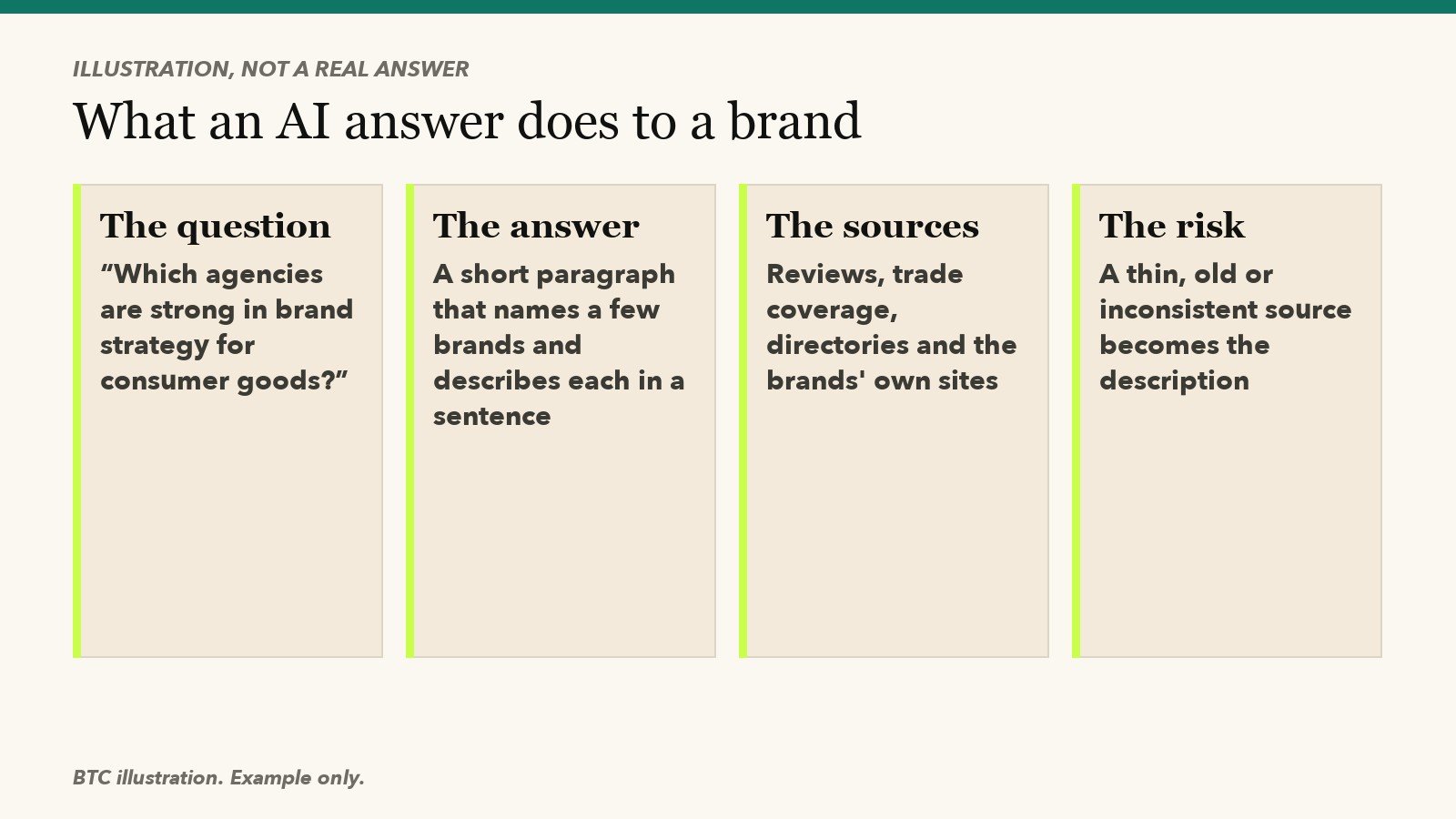
A growing share of research now starts with a question typed into an AI assistant instead of a search box. The answer comes back as a short paragraph that names a few brands and describes them, and often the buyer never sees a list of links. For a brand that paragraph is a new kind of first impression, and in most organisations nobody owns it.
This is the territory of generative engine optimisation, usually shortened to GEO and also called answer engine optimisation. Here is what it is, what the research says and what brand teams should do.
What GEO is
Traditional search optimisation aims to rank a page. GEO aims to be accurately included and described in an AI-generated answer. The difference is structural: search returns many results and lets the user choose, while a generative engine writes one response from a handful of sources and names a few brands inside it.
The term comes from academic research. In November 2023 Pranjal Aggarwal and co-authors published “GEO: Generative Engine Optimization”, later presented at the KDD 2024 data-mining conference. They built a benchmark of queries across domains and tested methods for making content more visible in generative answers. Their headline result was that some methods could boost visibility by up to 40%, with the effect varying by domain. The paper is on arXiv. It tested a specific benchmark and set of engines, so the number shows a direction, not a promise for any one brand.
A market has grown up around it. Webflow’s Generative Engine Optimization in 2026 report is one of several studies tracking the practice, and a range of platforms now sell visibility measurement across AI assistants.
Why this is a brand issue
Three features of AI answers matter to brand teams.
They describe, not just list. A search result is a pointer. An AI answer is a statement: this agency is known for X, this product is best for Y. If the statement is wrong, outdated or thin, it shapes consideration.
They draw on other people’s words. These systems lean on what third parties say about a brand, in reviews, trade coverage, directories and discussions, alongside the brand’s own site. A brand with strong, consistent coverage in credible places tends to be described more accurately.
They compress. An answer may name three brands. Being the third, or being left out, is a different outcome from ranking seventh on a page of results.
It also changes what a recognisable identity is worth. Our piece on why brands have about 1.5 seconds of attention made the case for being instantly recognisable to a person. The AI version of that test is whether a model can recognise and describe you in a sentence.
The overlap with classic brand work
Most of what improves how an AI describes a brand is good brand practice. That is worth saying plainly, because the market for GEO tools tends to promise special tricks.
- Say the same thing everywhere. If your site, press releases, directory listings and social bios describe the brand differently, a model has no clear picture. Consistent positioning language, facts and naming across public sources is the foundation.
- Publish clear, factual statements. Pages that state what the company does, for whom, where and with what evidence give a system material to quote. Definitions, specifications and data are easier to reuse than slogans.
- Earn credible third-party coverage. Trade press, analyst mentions, awards and reviews carry weight with systems that cross-check sources. This is communications and reputation work, not a new technical specialism.
- Fix errors at the source. If an answer is wrong because a directory or an old article is wrong, correct that source. There is rarely a way to correct the model directly.
- Keep structured data in order. Clean organisation, product and article data helps systems read your site. This is the technical part, and it is a small share of the work.
Measuring what AI says about you
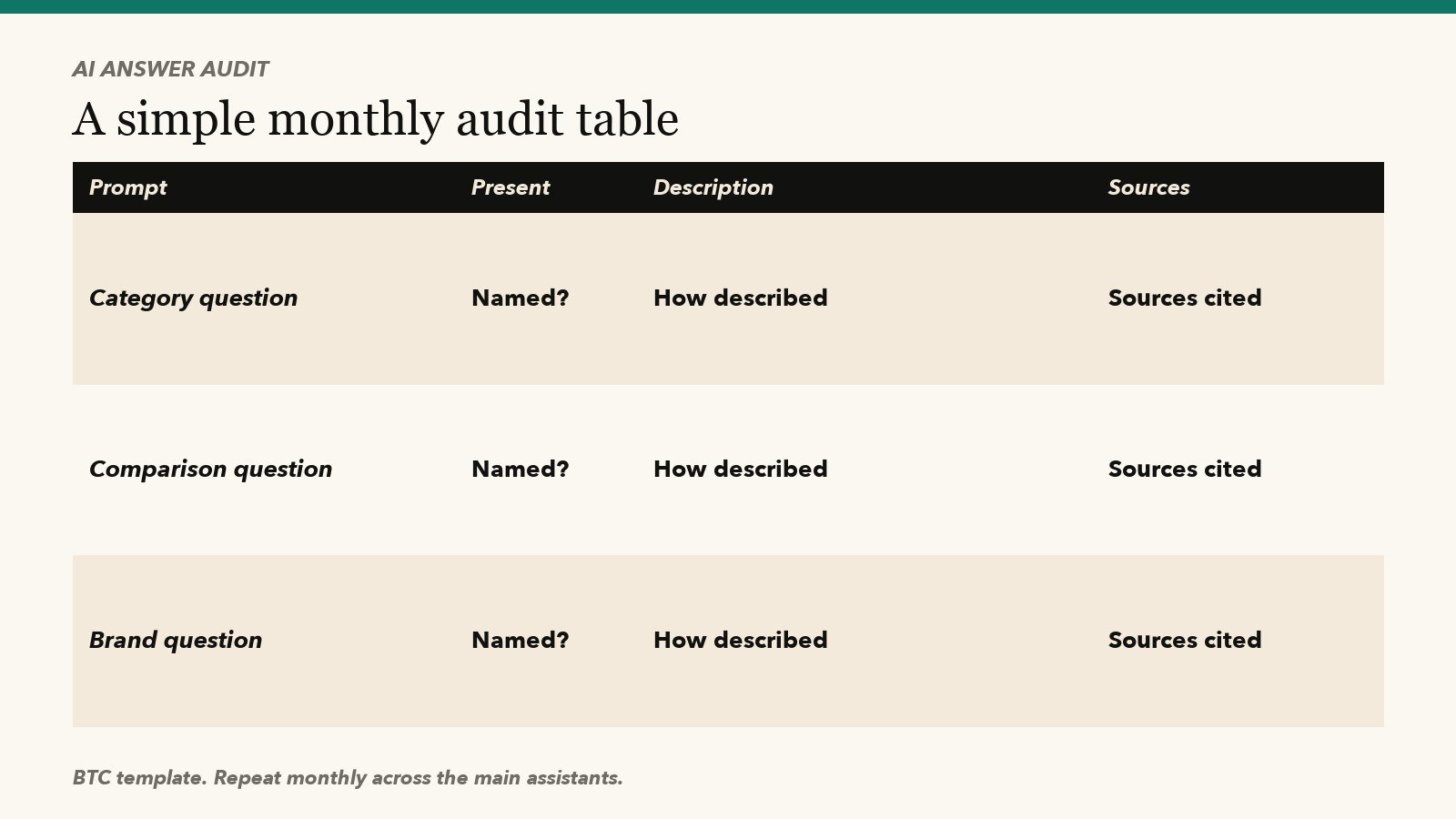
The first practical step is an audit. Ask the main assistants the questions your customers ask: category queries, comparison queries and brand queries. Record whether your brand is named, how it is described, which sources are cited and which competitors appear. Repeat monthly, because answers change.
Treat the results as a reputation dashboard with a few core measures: presence in answers, accuracy of description, sentiment and the sources that shape the answer. Several vendors now offer this as a service. Any vendor should explain its sampling method, because answers vary by prompt, time and user, and a single snapshot misleads.
What not to do
Be wary of three things. First, guarantees: nobody controls how a model answers, and a promise of guaranteed placement is a warning sign. Second, content written only for machines. Pages built for engines rather than people tend to be thin and can damage a brand’s voice, a risk we raised when looking at authenticity in an age of AI. Third, forgetting the human reader. People still read, trust and share, and a brand that is clear to a person is usually clear to a model.
Some brands are taking a stand on AI itself. Dove pledged never to use AI in its advertising, which is a brand statement in its own right. More often marketers are using AI for personalisation and efficiency, as in our report on marketers turning to AI. GEO sits on the other side of the same shift: the audience is using AI too.
Also readHow AI is changing brand identity work in 2026
Who should own it
Ownership is the practical gap. The work crosses brand, communications, content and technical teams. A sensible arrangement gives the brand team accountability for how the brand is described, with communications and content as delivery partners and the web team handling structured data. Without a named owner the work falls to whichever team notices first.
What to Watch
Watch the monthly answers across the major assistants for your category: if your brand is named less often than competitors or described inaccurately, fix the underlying sources and positioning language first, and only then consider paid GEO tooling.