

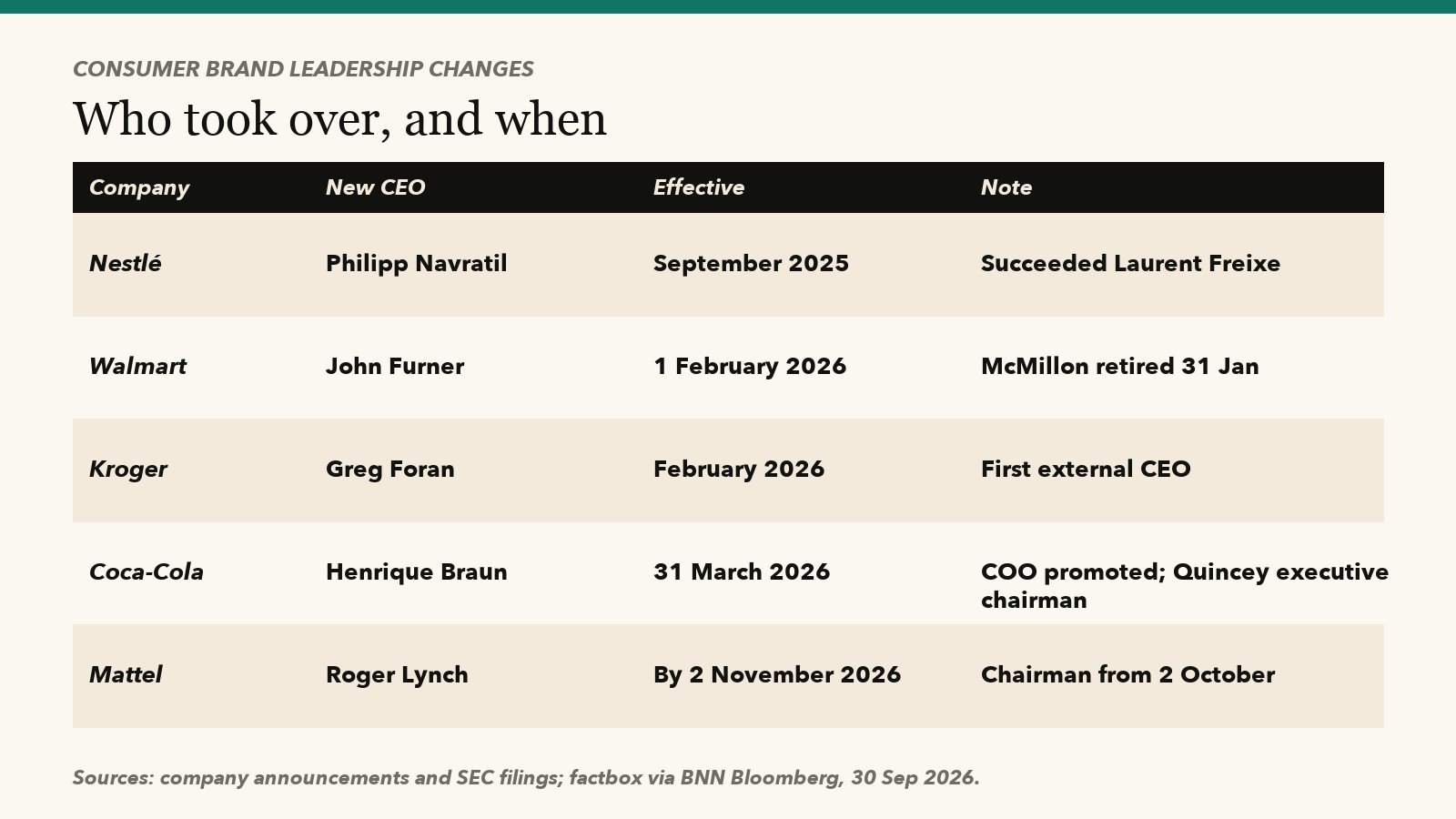
A factbox carried by BNN Bloomberg on 30 September listed the leadership changes sweeping global consumer goods and retail companies over the past year. Walmart, Nestlé, Coca-Cola, Kroger and Mattel all have new chief executives, among many others. The reasons differ, from planned succession to pressure. The pattern for brand teams is more consistent than the headlines suggest. We read the list as a map of brand risk. Each change is a point where strategy, portfolio and marketing spend are open for review. Here is what the first year tends to touch, using the clearest examples.
Walmart and Coca-Cola: continuity with a new voice
Walmart’s change was a planned handover. John Furner succeeded Doug McMillon as president and chief executive on 1 February 2026, with McMillon retiring a day earlier. Furner had been running Walmart U.S. since 2019 and first joined as an hourly associate in 1993. Coca-Cola made a similar kind of move: Henrique Braun, its chief operating officer, took over as chief executive on 31 March 2026, with James Quincey staying on as executive chairman. In brand terms an internal succession says the strategy stays and the delivery changes. Walmart’s recent moves show how much of its brand work now sits in its own labels, from the launch of its largest private food brand in 20 years to the new fashion brand that does not carry the Walmart name. A new chief executive inherits a portfolio already being reshaped and will be judged on how well that continues.
Nestlé: the clearest case of a brand-led reset
Nestlé offers the most detailed picture. Philipp Navratil became chief executive in September 2025, succeeding Laurent Freixe. He is a Nestlé insider with about 25 years at the company, and he has moved quickly. He is reorganising the group around four pillars: coffee, petcare, nutrition and health, and food and snacking, replacing a regional structure and six strategic business units. The job cuts are large, 16,000 positions, about 6% of the workforce. And in The Drum, Mark Ritson described a marketing-first reset: spend is rising to about 9% of revenue, up from 7% in 2022, with roughly 70% going to digital and first-party data covering 400 million people. Ritson’s point is that Navratil is treating brand marketing as an operating discipline, with a clearer marketing hierarchy, better-trained general managers and marketing and finance sharing responsibility for the profit and loss. Whether or not you agree with every step, that is a chief executive treating brand as a CEO job.

Nestlé’s brand work spans categories, from its plant-based beverage expansion to its decision to disclose nutritional value across its entire portfolio. A simpler portfolio structure makes work like that easier to coordinate.
Kroger and Mattel: two outside hires, two different bets
Kroger took the opposite route to Walmart. In February it named Greg Foran, who ran Walmart U.S. from 2014 to 2019 and most recently led Air New Zealand, as chief executive, its first external appointment after a search of almost a year. Hiring from a rival signals that the board wants a different playbook, and for a supermarket chain that puts pricing, store experience and own-brand strategy under review. Mattel’s pick is a different kind of outsider. It chose Roger Lynch, the chief executive of Condé Nast, to lead a toy company, a sign that the board sees its characters as media assets as much as products. That is a strategy statement dressed as a succession, and the man he replaces is reported to be heading for the combined Paramount and Warner Bros. group, a merger that puts many brand identities in question.
What new leaders change first
Across these examples a first-year pattern shows up.
- The portfolio. Leaders simplify before they expand. Nestlé’s four pillars reduce the number of things a brand team has to explain and fund.
- The marketing budget and its mix. The share of revenue spent on marketing, and the split between digital and brand building, is often the first visible choice a new boss makes.
- The organisation of marketing. Who owns the brand, how marketing sits against finance and how local teams are governed tend to change before any creative work does.
- The story. A new identity or campaign usually arrives in year two, once the structure can support it.
What brand teams should do
Assume the strategic review will reach your category within months of a new chief executive arriving. The practical response is to have the brand’s measurable value ready: awareness, consideration, price premium and share of voice, in terms a finance chief respects. Brands that can show what they earn are protected when portfolios are cut. Brands that cannot become candidates.
What to Watch
Watch where new chief executives place marketing in the reporting line and how much of the budget they protect in the first year, because those two choices usually show whether a consumer brand is being run for growth or for cost.