Agency M&A in 2026: Who's Buying Who and Why It Matters


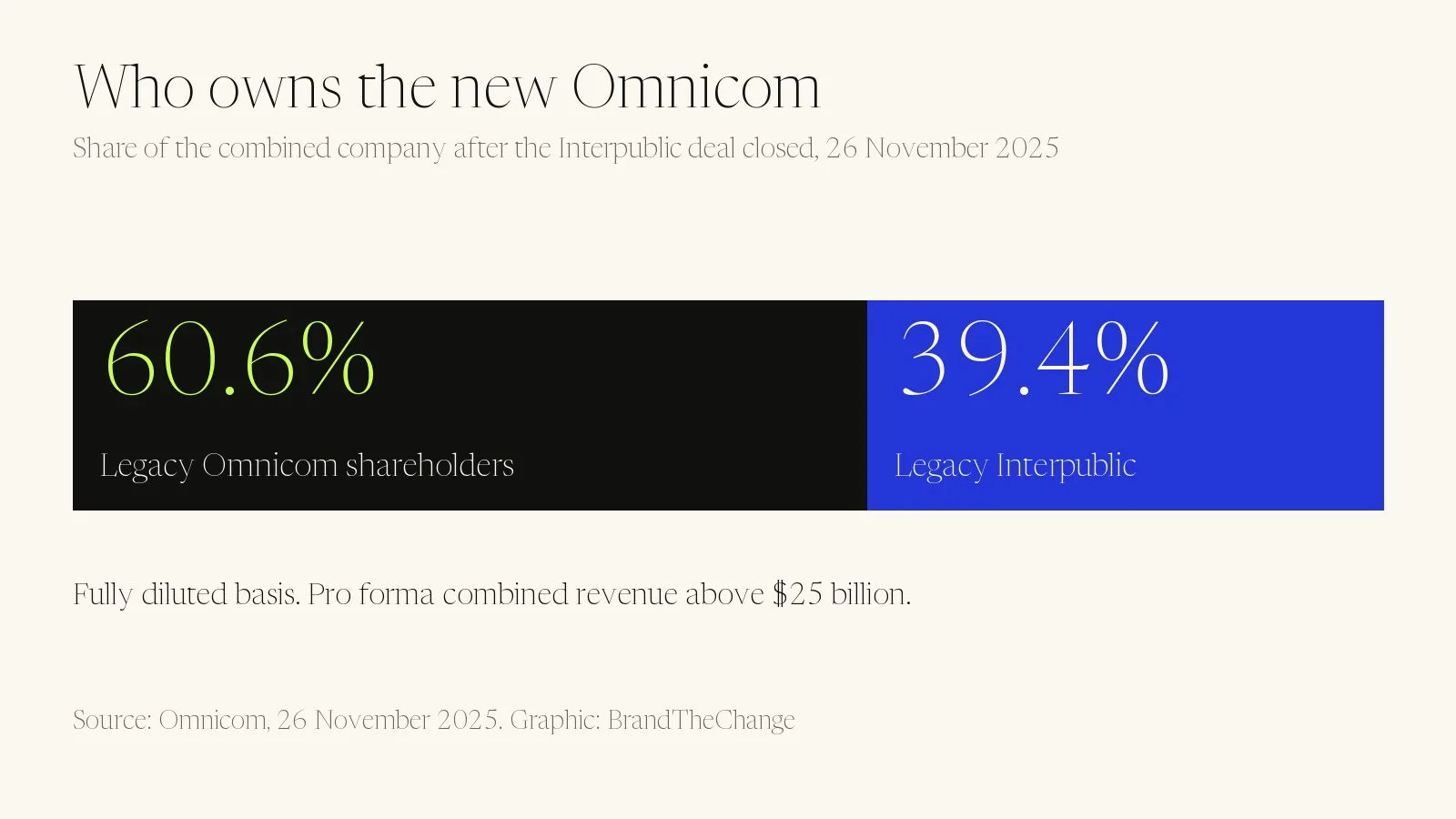
Agency M&A has restructured the holding company era that defined advertising for four decades. In 2025 and into 2026, a wave of mergers, acquisitions, and internal consolidations has reshaped the competitive landscape at the top of the market, sending clear signals about where the industry believes the next decade of competitive advantage will be built. The headline deal is Omnicom’s $13 billion acquisition of Interpublic Group, which closed in November 2025 following European regulatory approval. The deal creates the world’s largest advertising holding company: a combination of two networks that included BBDO, DDB, FCB, McCann, MullenLowe, Weber Shandwick, and dozens of specialist agencies. Omnicom then retired DDB, FCB and MullenLowe as networks, keeping BBDO, TBWA and McCann as its three global creative networks. The era of the Big Five holding companies is functionally over. We are in the era of the Big Three: the new Omnicom-IPG entity, Publicis Groupe, and WPP, with Dentsu and Havas operating at significantly smaller scale. Understanding what these deals mean requires looking beyond the transaction values to the strategic logic driving them.
The AI Thesis
Every major consolidation move in the holding company market over the last eighteen months has the same underlying rationale: artificial intelligence infrastructure is expensive, and scale is the mechanism for funding it. Publicis Groupe reported 5.4% organic growth in the first half of 2025, kept investing heavily in AI and talent, and raised its full-year organic growth guidance to close to 5%. The financial case is clear: AI infrastructure investment at scale produces a competitive advantage in delivery efficiency, data integration, and margin that sub-scale networks cannot match. The Omnicom-IPG merger was structured, at least in part, around the same thesis. A combined entity with the combined data assets, technology investment capacity, and client relationships of both networks is better positioned to build proprietary AI platforms than either network operating independently. For clients, this translates to different things depending on how you look at it. The optimistic reading is that AI-funded scale produces better, faster, more data-integrated work at competitive cost. The sceptical reading is that consolidation reduces the competitive tension that historically drove agency quality and innovation.
Publicis: The Strategic Winner So Far
Of the major holding companies, Publicis has most visibly executed a strategy rather than reacted to circumstances, raising its guidance on the back of new business wins and sustained investment.
WPP: Contraction and Questions
The most significant story on the other side of the ledger is WPP. The group’s third-quarter 2025 revenue fell 8.4% on a reported basis (down 3.5% like-for-like), and CEO Cindy Rose described the performance as “unacceptable.” The group’s media operations now sit under WPP Media rather than the GroupM brand. The WPP Elevate28 restructure followed. WPP’s situation is structurally complex. The group’s portfolio of agencies, historically its competitive advantage, includes some of the most recognised names in the industry: Ogilvy, Grey, VML, Wunderman Thompson. But the integration of those agencies under a coherent technology and data strategy has lagged behind Publicis. The gap in AI investment between WPP and Publicis is real, and it is showing up in client revenue trends. The contraction also has a talent dimension. When a holding company contracts, its most mobile talent, senior creative directors and strategists who have market options, makes decisions accordingly. The next twelve months will test whether WPP’s restructuring stabilises the revenue decline or whether the talent and client exodus compounds.
What This Means for Brands and Independent Agencies
The mid-tier, networks too large to be nimble independents, too small to fund proprietary technology, faces the sharpest strategic pressure.
For brand clients, the consolidation creates both opportunity and risk.
Also readPublicis Is Buying 160over90. Sports and Culture Are Now the Agency Assets Everyone Wants.
The opportunity: larger combined networks have broader specialist capability, deeper data assets, and, in theory, better integration across the disciplines, creative, media, PR, CRM, digital, that fragmented holding company relationships have historically made difficult. The risk: client conflict management becomes more complicated as networks grow larger. Clients who previously had clear separation from competitors within a holding company now face more complex conflict landscapes as two networks merge their client rosters. For independent agencies and specialist brand consultancies, the consolidation wave creates a genuine strategic opening. The best creative talent in the industry does not universally want to work inside mega-networks. The most ambitious clients, particularly in categories where genuine creative quality is a competitive weapon, are often better served by independent shops that can offer senior creative and strategic attention without the account management overhead of holding company structures. The independents who articulate this clearly, demonstrate it in their work, and price it appropriately are finding the M&A wave to be more tailwind than headwind.
The Longer View
The holding company consolidation wave is not finished. S4 Capital has been in merger discussions with MSQ Partners, reflecting pressure on sub-scale digital networks that cannot fund the AI infrastructure investment the market now expects. The mid-tier, networks too large to be nimble independents, too small to fund proprietary technology, faces the sharpest strategic pressure. The competitive architecture of the industry in 2030 will look substantially different from 2020. The question for every agency, at every scale, is whether it is making decisions that reflect that reality or ones that assume the structure of the last decade will persist. The deals suggest the major players have made their bets. The results will take five years to fully evaluate.
Keep reading