Why B2B Brands Are Finally Taking Design Seriously


For a long time, the conventional wisdom about B2B brand design was that it did not matter. B2B brands, the thinking went, did not need to look good. Buyers were rational. Decisions were made by procurement committees working through spreadsheets. Brand identity was a nice-to-have that belonged to the marketing budget alongside trade show stands and branded golf balls. That conventional wisdom was always wrong. It is now visibly, expensively wrong. And the B2B market is catching up fast.
The Evidence Has Arrived
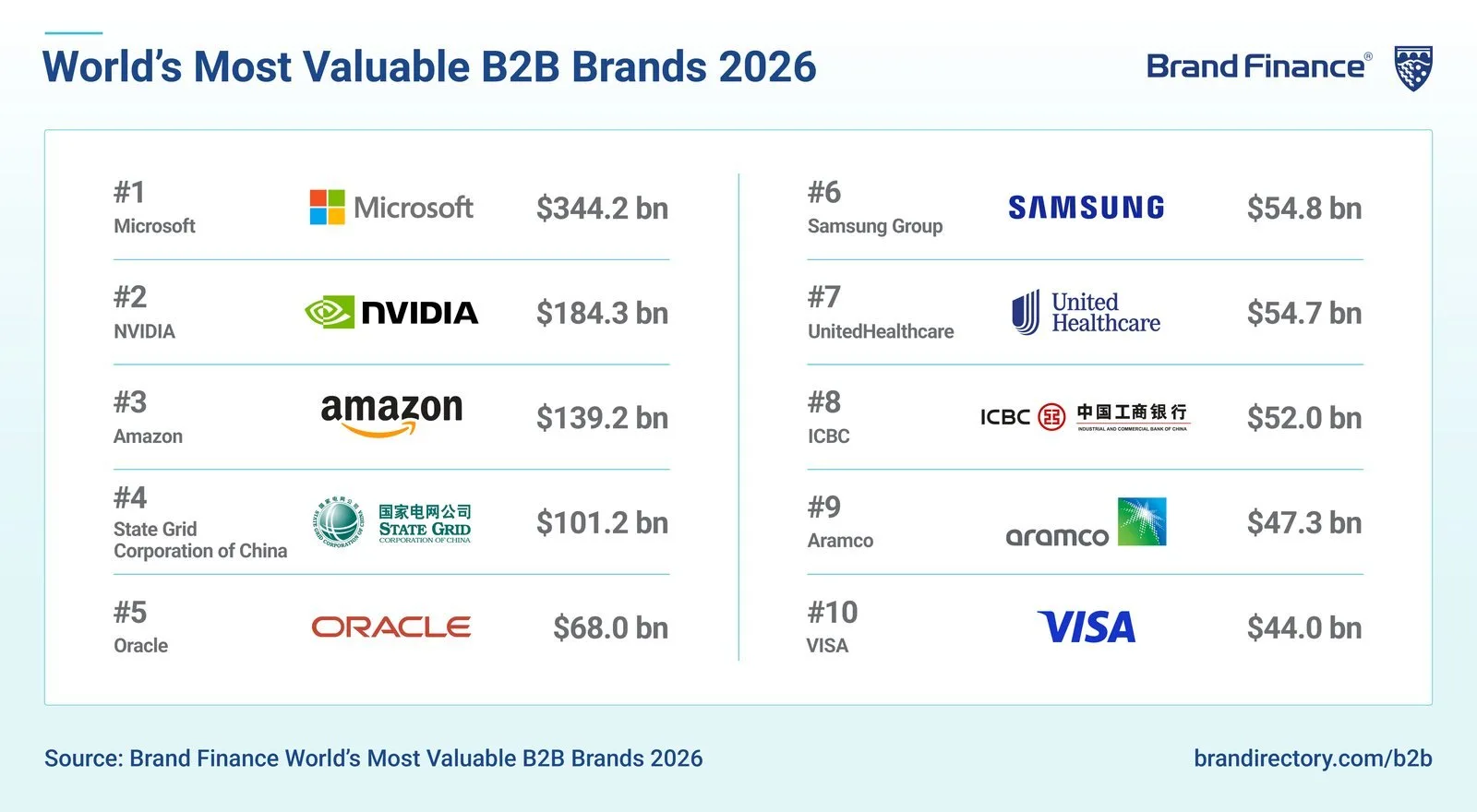
The Brand Finance World’s Most Valuable B2B Brands 2026 report makes the financial case clearly. Microsoft leads at $344.2 billion in B2B brand value. NVIDIA follows at $184.3 billion. Amazon at $139.2 billion. These are not just brand rankings, they are valuations with direct financial implications. Companies with stronger branded businesses command a 65% premium in forward price-to-earnings ratios. Investors are willing to pay significantly more for every dollar of profit a strong brand generates. This is not soft. It is a financial multiplier that shows up in how markets value B2B businesses. The implication is uncomfortable for any B2B leadership team that has historically treated brand as a cost centre:
The brand investment you did not make is visible in your valuation gap.
Why B2B Brand Was Underinvested for So Long
The rational buyer myth was the primary reason. The assumption was that B2B purchasing decisions were purely functional, spec sheets, references, pricing, procurement process. Emotion was a consumer thing. Brand was for people buying trainers, not enterprise software licences. The research has consistently disagreed with this. B2B buyers are humans making decisions in organisational contexts that create uncertainty, risk, and political exposure. In those conditions, brand trust, the prior belief that a vendor is competent, stable, and credible, does an enormous amount of the work that functional evaluation is supposed to do. The difference between a B2B brand decision and a consumer brand decision is not the presence of emotion. It is the nature of the emotion involved. B2B buyers are managing professional risk, not just personal preference. Brand that communicates competence, reliability, and sophistication addresses that professional risk directly. The second reason for underinvestment was category permission. B2B design operated within a very narrow range for decades, corporate blues and greys, conservative typography, imagery that said “enterprise” in the most literal possible way. The category convention was so strong that deviation from it felt risky. Looking different from your B2B competitors seemed to signal that you were not serious.
Who Changed the Convention
The shift started with a generation of B2B software brands that decided the category convention was an opportunity rather than a constraint. Mailchimp rebranded with expressive illustration, a distinctive yellow, and a personality that was warm and slightly absurd, completely unlike every email marketing platform before it. The brand found enormous reach with exactly the audience that traditional B2B design would have alienated: small business owners who were not procurement professionals and who responded to warmth over formality. Notion built a product with a brand personality so integrated into the experience that the two are inseparable. Stripe used mathematical rigour and visual precision as brand signals that communicated reliability to a developer audience who understood those signals at a level that conventional enterprise design did not. Each of these brands made the same strategic bet: that their buyers’ decision-making was not purely rational, and that brand design could reach the part of the decision that the feature comparison could not.

They were right. And the evidence of their commercial success has made the bet available to the wider B2B market.
Also readHow Udora’s Rebrand Went Beyond Visual Identity
What Is Changing Now
The firms now investing seriously in B2B brand design, John Deere, McKinsey, Siemens, among others, are not doing it because design trends shifted. They are doing it because the financial evidence for brand investment has become difficult to ignore, and because a generation of buyers who grew up with well-designed consumer products now runs procurement committees. The buyer has changed. The buyer expects more. Practically, this is showing up as investment in modular design systems that allow consistent visual identity to scale across global organisations, not just a logo and a colour palette but a flexible visual system that can be maintained and extended by distributed teams without design drift. It is also showing up as a shift in brand personality. B2B brands in 2026 are moving away from the studied neutrality of enterprise aesthetics toward more expressive, human-first positioning. Bold colours. Distinctive typography. Messaging that has a point of view. The aim is to build emotional bonds with buyers who are, despite what the conventional wisdom says, making emotionally inflected decisions.
The Honest Observation
B2B brand specialists have been making this argument for fifteen years. The audience for that argument, B2B marketing leadership and CFOs, was not ready to hear it until the financial evidence arrived. It has arrived. Companies with strong B2B brands are worth more. The buyers making purchasing decisions are responding to design and brand personality in ways that procurement models do not capture. The category conventions that kept B2B design conservative are dissolving because the brands that broke them are demonstrably winning. The B2B brand design shift is not a trend. It is a structural correction of a decades-long underinvestment in one of the most financially significant forms of brand equity there is.
Keep reading