Small Brand Studios Are Being Acquired. What 617 Collective’s Nominee Deal Signals.


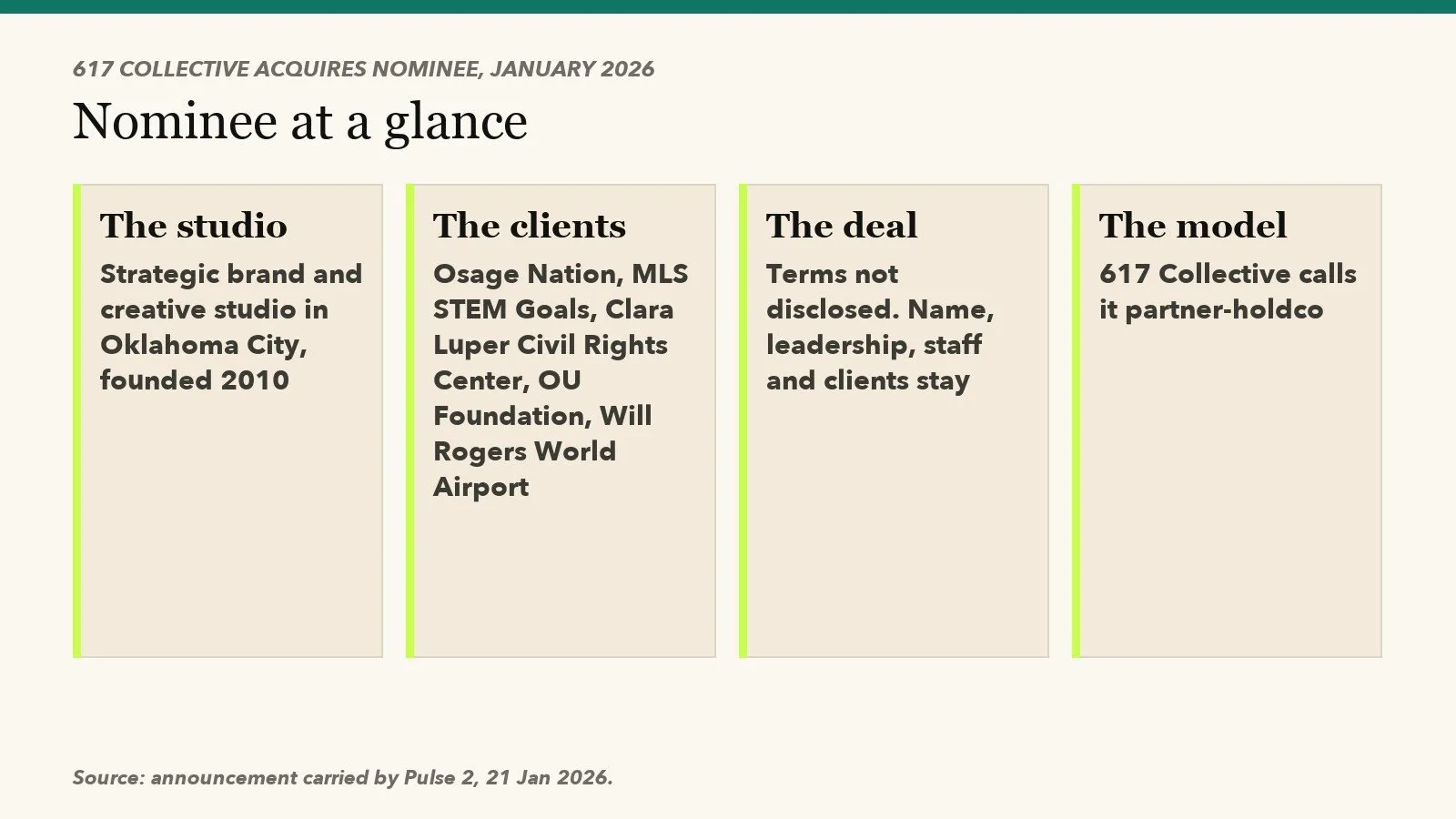
Agency consolidation is usually a story about the biggest groups. The more telling deals are small ones. On 21 January, New York-based 617 Collective announced it had acquired Nominee, an Oklahoma City brand and creative studio founded in 2010. Terms were not disclosed. Nominee keeps its name and leadership team, and 617 Collective said it does not expect changes to staff, client relationships or day-to-day operations. The structure is what makes it interesting. 617 Collective calls its approach “partner-holdco” and presents it as an alternative to traditional agency roll-ups that centralise operations and absorb what they buy.
What was agreed
Nominee works for corporate, nonprofit and civic clients. Its project list in the announcement includes the Osage Nation, MLS STEM Goals, the Clara Luper Civil Rights Center, the OU Foundation and Oklahoma City’s Will Rogers World Airport. It describes its practice as human-centred brand building, thoughtful design and storytelling. 617 Collective describes itself as a holding company focused on founder-led marketing, PR and creative agencies. Managing partner Cynthia Monroy framed the thesis: “Scale has too often come at the expense of culture, creativity, and founder leadership.” Nominee founder and chief executive Matt Stansberry said his team cares “deeply about the human impact of design” and believes “responsible branding drives remarkable work.” Partner Bryan Clifton added: “Enduring brands are built by empowered teams, not centralized control.” The details were carried in an announcement published by Pulse 2.
Holding companies used to buy agencies to absorb them. The new model buys them to leave them alone.
The partner-holdco idea
In a standard roll-up the buyer merges back-office functions, consolidates brands and tends to move clients onto shared contracts. That produces savings, and it also removes much of the reason a client chose the small studio in the first place. A partner-holdco keeps the studio’s identity, leadership and client relationships. The parent supplies shared infrastructure, strategic guidance and long-term capital. For the founder the offer is liquidity and support without losing what makes the studio distinctive. For the parent the bet is that a portfolio of strong independent studios is worth more than one blended agency. Whether that holds depends on discipline. A holding company that promises independence still needs governance, and the line between support and control is easy to cross. The first test comes when a studio’s priorities differ from the group’s.
Why brand studios are in demand
At the big end, groups are reshuffling what they consider core. Experiential agencies are leaving the holding companies: Jack Morton’s move from Omnicom to Impact XM, a private-equity-backed rival, is one example. Specialist disciplines are being moved out of the big networks, and somebody has to be the new home. Elsewhere, networks are buying capability instead: Publicis acquired Influential to own the creator market, and Havas streamlined its brand architecture and visual identity as it reorganised. A founder-led partner-holdco serves a different logic. Strategic brand and design studios are scarce, hard to scale and dependent on a few senior people. Clients, especially in the public, nonprofit and civic sectors, often value that closeness. A buyer that preserves it can keep the talent and the clients together.

What independent studios should weigh
Founders considering a sale should look at three questions. What stays independent in writing? Name, leadership, client contracts and creative control should be set out in the agreement, not left to goodwill. Where does the group add value? Capital, shared services and access to bigger clients are real benefits. Pressure to adopt group tools, pricing or conflict policies is a cost. What is the exit? A partner-holdco that is itself sold later can put an independent studio back inside a traditional group.
What clients should ask
Clients of an acquired studio should ask the same things. Who owns the relationship? Are the senior people contractually tied in? Will the studio still work for competitors of the parent’s other agencies? A group that keeps its studios separate should be able to answer in writing.
What to Watch
Watch whether 617 Collective’s next acquisitions also keep their names and leaders: if the partner-holdco model holds across several deals, independent brand studios have a credible alternative to selling into a conventional group, and clients get a clearer test of independence.
Keep reading