World Cup 2026 Ads: More Celebrities Than Ideas

WARC forecasts that the 2026 World Cup will add about $10.5 billion to global ad spend in the quarter it runs, though its pull on advertisers is weaker than before. Sixteen host cities across three countries. One of the largest commercial sporting events ever staged, and every brand with a global ambition has planted a flag. Their ads all sit inside the same FIFA World Cup 2026 identity. Most of them produced a World Cup ad. Fewer produced a World Cup campaign. And a small number produced something that will still be referenced in 2030 when the briefs for the next tournament land. The gap between those categories is the most instructive thing about this advertising cycle. What follows is a review of the campaigns that shaped it: what was made, what it said, what worked, and what previous World Cups tell us about why some of it will last and most of it will not.
The Campaigns: Brand by Brand
Nike: “Rip the Script”
Nike’s six-minute film, created by Wieden+Kennedy and directed by Dan Streit, is the most technically ambitious piece of commercial work in this cycle. The cast runs to more than thirty names: Kylian Mbappé, Vinícius Júnior, Erling Haaland, Alexia Putellas, Cristiano Ronaldo, LeBron James, Travis Scott, Kim Kardashian, Channing Tatum, Young Miko, LISA of BLACKPINK, Jason Sudeikis reprising Ted Lasso, Central Cee. The premise: football’s next generation should ditch the playbook, trust instinct, and play with creative joy rather than calculated efficiency. “Rip the Script” is a masterclass in brand architecture and a cautionary tale about what happens when star power substitutes for a singular idea. Nike knows how to do this. The 1998 Ronaldo airport final, the 2022 Footballverse, the Joga Bonito campaign from 2006: each had a specific cultural argument embedded inside the celebrity spectacle. “Rip the Script” has a mood and an ethos, but it does not have an argument. “Play with instinct and joy” is not a new Nike position. It is Nike’s permanent position, restated with a bigger budget. What the film gets undeniably right is atmosphere. It feels like a Nike film. The cultural range of the cast, spanning sport, music, fashion, film, and comedy, signals what Nike wants football to mean in North America specifically: not a niche immigrant sport catching up to the mainstream, but a fluid cultural form that belongs to everyone. That is a real strategic idea. It surfaces more in the casting choices than in the writing.
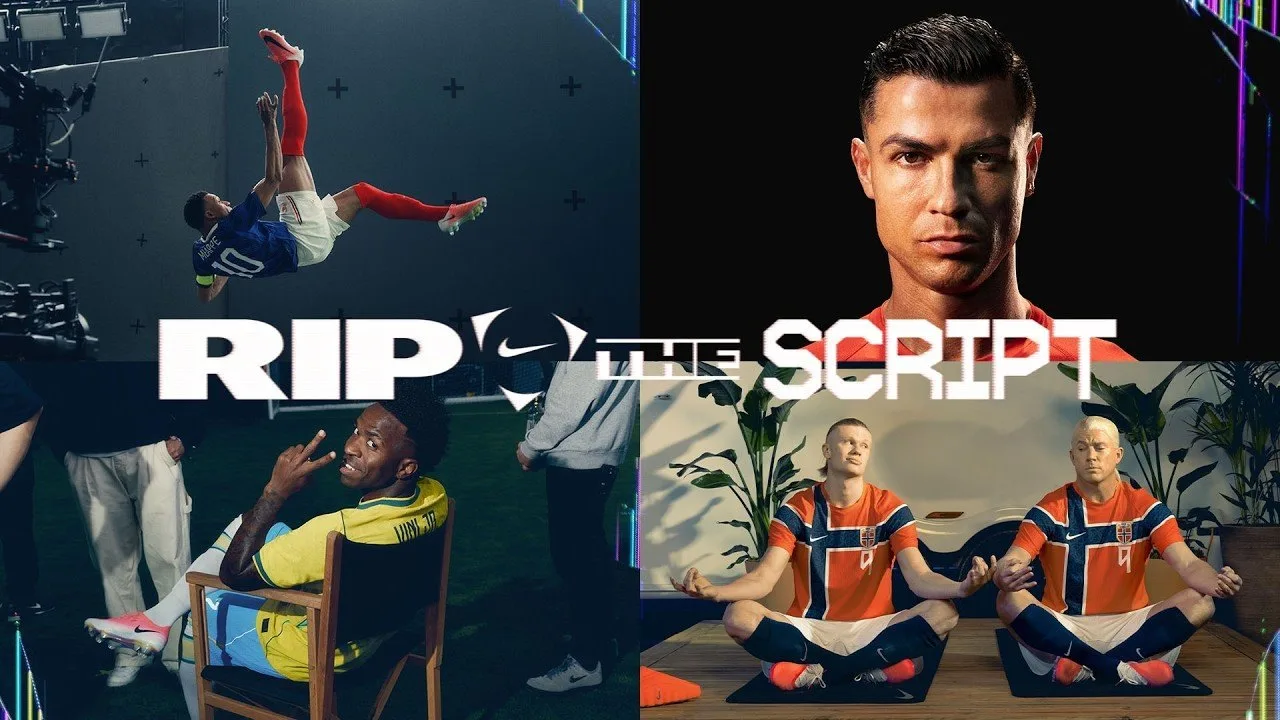
The honest question for Nike after this cycle: is a six-minute film with thirty-plus celebrities a campaign, or is it a brand portfolio activation wearing a campaign’s clothes?
Adidas: “Backyard Legends”
The five-minute film from LOLA USA, directed by Mark Molloy and produced by SMUGGLER, opens with Timothée Chalamet on a street corner trying to build a team capable of defeating a legendary local crew called Clive, Ruthie, and Isaak. The recruits he assembles: Jude Bellingham, Lamine Yamal, Trinity Rodman, Lionel Messi, Bad Bunny. Legacy players appear through AI de-aging: David Beckham, Zinedine Zidane, Alessandro Del Piero. The creative platform extends Adidas’s “You Got This” positioning. The tone is 1990s street football nostalgia filtered through 2026 production values: analog textures, era-specific styling, analogue technology, an ensemble soundtrack. The film is unambiguously fun. “Backyard Legends” is the best traditional football ad of this cycle, and it earns that position through a specific creative decision that most brands failed to make: it found a story with a narrative spine. There is a setup, a challenge, a process of recruitment, a payoff. Chalamet is not window dressing. He is a protagonist with a goal. The viewer is pulled through the film rather than presented with a succession of impressive images. The de-aging work on Beckham, Zidane, and Del Piero deserves a note. Elsewhere in this advertising cycle, AI-generated and AI-manipulated visuals drew immediate audience backlash because the technique was visible and served no creative purpose. In “Backyard Legends,” the technique serves the story: the whole point is that legends from different eras exist in the same magical backyard universe. The AI work is not a production shortcut. It is a creative choice. That distinction mattered, and audiences responded to it. The campaign also bridges entertainment, music, and football in a way that travels. Chalamet and Bad Bunny bring the film into entertainment and music conversations. Beckham and Messi carry it into football and fashion. Yamal, Bellingham, and Rodman keep it present-tense. It is, in structure, what most brands attempted and most did not achieve.
LEGO: “Everyone Wants a Piece”
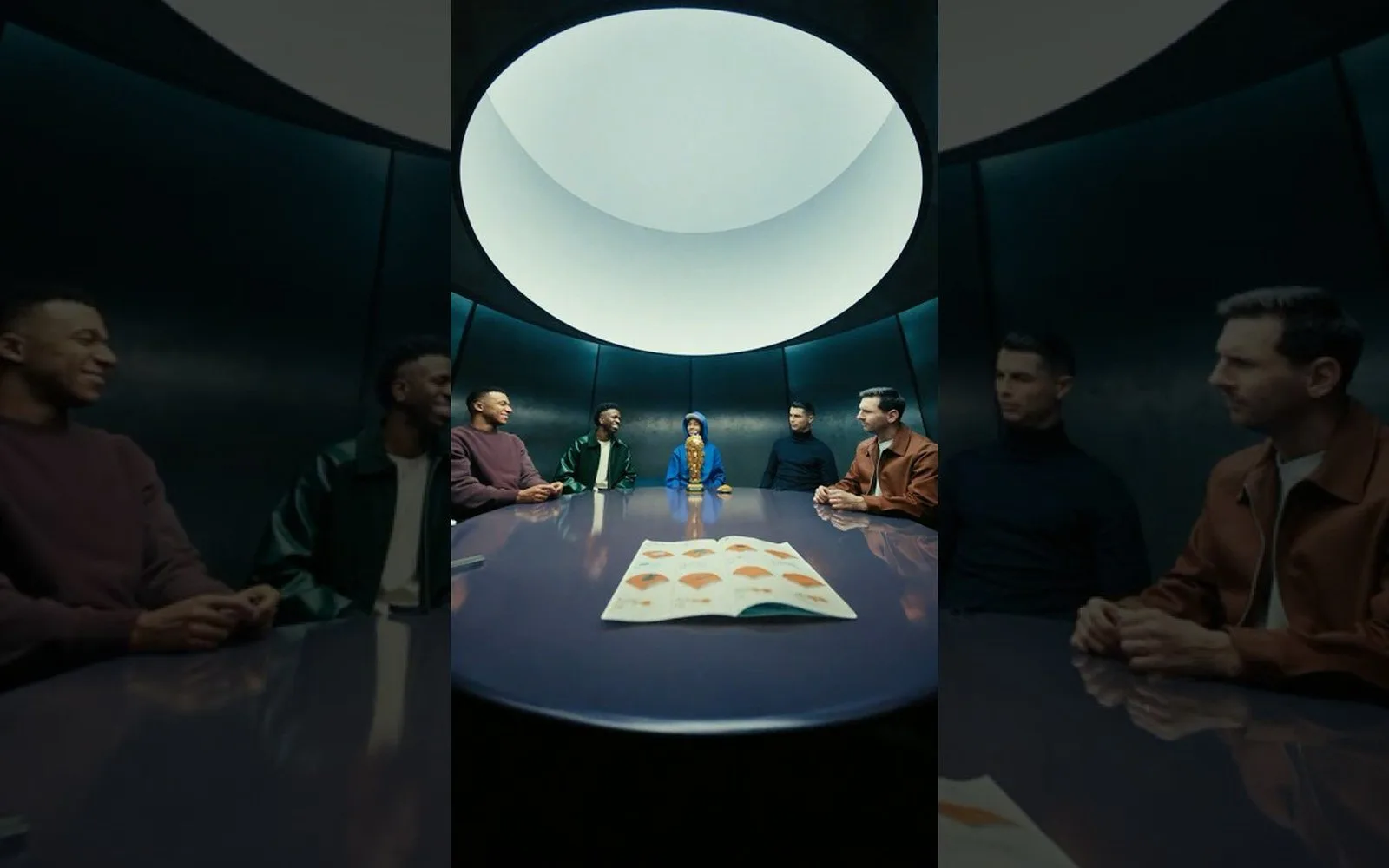
Sixty seconds. Four players: Lionel Messi, Cristiano Ronaldo, Kylian Mbappé, Vinícius Júnior. A table. A LEGO version of the FIFA World Cup trophy being built, brick by brick. At the end, a child finishes it. Reported at 314 million views across the players’ Instagram accounts within 24 hours of release. By almost any metric, the single most effective campaign unit produced in this cycle. The LEGO campaign deserves more serious analysis than it typically receives, because it solved a creative problem that most brands with expensive budgets and famous faces could not. The problem: how do you get Messi, Ronaldo, Mbappé, and Vinícius Júnior in one room without the ad feeling like a stunt? The answer LEGO found is deceptively simple. Build a context where the activity, not the fame, is the point. Four people sitting around a table building something together strips away competition and comparison. The rivalry storyline that would have been the obvious (and wrong) creative choice is absent. The final image, a child finishing the build, reconnects the ad to the actual product and the actual audience. It is also genuinely moving, which is rare in a cycle dominated by production scale rather than emotional truth. The LEGO campaign did not spend the most or cast the broadest. It had the sharpest single idea. The comparison to previous World Cup work is instructive. Nike’s 2006 Joga Bonito and Adidas’s 2010 campaigns were both remembered for specific moments of emotional clarity. LEGO produced that for 2026 with a fraction of the runtime.
Coca-Cola: “All the Feels”
Coca-Cola structured its World Cup campaign as a three-film trilogy: “Bubbling Up” (January 2026, pre-tournament excitement), “Uncanned Emotions” (April 2026, building anticipation), and “No Better Feeling” (tournament kickoff). The films avoid player appearances entirely, placing the emotional experience of football fandom: the giddiness, the anxiety, the shared catharsis, at the center instead. The campaign anthem remakes Van Halen’s 1983 “Jump” with J Balvin, Amber Mark, Steve Vai, and Travis Barker. Coca-Cola made a structurally sophisticated decision that separates it from most campaigns in this cycle: it did not spend its way into the player marketplace. Instead of paying for Messi or Mbappé, it built its entire creative around the fan rather than the star. This is consistent with Coca-Cola’s strongest World Cup work historically. The 2010 K’Naan “Wavin’ Flag” anthem became the defining sound of that tournament not because it featured famous football players but because it expressed something true about joy, resilience, and belonging that millions of people felt. The 2026 “Jump” remake operates on the same logic. It is an emotional platform, not a star showcase. The risk is that emotion without specificity becomes wallpaper. “All the Feels” is a real campaign thought, but the trilogy structure dilutes it. By the third film, the emotional range the campaign covers has been well-established. The brand is in danger of scoring a technically correct goal and then putting the ball back on the penalty spot. The Van Halen cover is the boldest single creative decision in the campaign. It is either the most memorable or the most divisive thing Coca-Cola does at this World Cup, and probably both.
Lay’s: “Jump On, America” (Bandwagon Campaign)
Will Ferrell drives a yellow-branded Lay’s truck across the United States, picking up fans along the way and encouraging Americans to embrace being “bandwagon fans” of football. David Beckham appears. Marshawn Lynch appears. The tone is self-aware and deliberately absurd. Created by 72andSunny. Lay’s identified the most specific strategic insight in this entire advertising cycle and executed it with precision. The insight: football is new to most American households at World Cup level. The usual brand response to that insight is to pretend it is not true and make a reverential football ad that American audiences do not feel. Lay’s did the opposite. It made the outsider status the joke and the invitation simultaneously. “Bandwagon fan” is an internet insult. Lay’s turned it into a badge. The creative is honest about what Lay’s is selling: permission to join a party you were not at from the beginning. Ferrell is pitch-perfect casting because his entire persona is built on enthusiastic, uninformed participation in things he does not quite understand. This is the most North America-specific insight in the 2026 ad cycle, which means it will not travel globally but it does not need to. It knows its audience and it serves that audience with specificity and humor. In a cycle full of global pretensions, that counts as a rare virtue.
McDonald’s: “Fan Faves”
McDonald’s produced its largest-ever World Cup activation, spanning more than 100 markets. Created by Wieden+Kennedy New York, the campaign features David Beckham, Ronaldinho, Thierry Henry, Lamine Yamal, Son Heung-min, Christian Pulisic, Santiago Giménez, and Alphonso Davies. The central idea: every football fan has a favorite McDonald’s order, and so does every football star. Films show the players relaxing in restaurants, interacting with mascots (Grimace, the Hamburglar), and ordering their go-to meals. A collectible cup series gives the campaign a retail activation layer. McDonald’s made the right choice by building around a truth that belongs to the brand rather than renting a football narrative it does not own. “Every fan has their order” is a McDonald’s insight, not a football insight. It happens to be activated around the World Cup, which gives it scale without requiring the campaign to be about the tournament itself. The intergenerational casting, legends (Beckham, Ronaldinho, Henry) alongside current stars (Yamal, Davies, Pulisic), works naturally because the campaign’s emotional argument is about comfort and familiarity, which ages well by design. This is the campaign most likely to still be running in some form after the tournament ends, because it is not dependent on the World Cup being live. The mascot integrations (Grimace appearing on screen with Lamine Yamal) are either charming or bewildering depending on your relationship with the McDonald’s brand ecosystem. For anyone under eighteen, they are almost certainly charming.
Pepsi: “Football Nation”
Pepsi’s campaign builds an imagined Football Nation: a country with its own rules, culture, and citizens, anchored by David Beckham as a kind of benevolent footballer-president, with Mohamed Salah, Vinicius Jr., Alexia Putellas, Florian Wirtz, and Gordon Ramsay in supporting roles. The world-building has a slightly absurdist tilt. Pepsi has a tradition of World Cup campaigns that try to occupy the cultural edge that Nike and Adidas hold in football: irreverent, star-dense, slightly chaotic. The 2002 and 2006 Pepsi campaigns with Beckham, Ronaldinho, and Henry at their peaks are remembered as genuine cultural artifacts. “Football Nation” is a solid execution of an idea that needed to be ten percent stranger to fully land. The world-building premise is actually smart. In a cycle where most brands did player showcase plus emotional voiceover, Pepsi built a concept. The problem is that the Football Nation idea has more potential than the film exploits. The rules of this imagined country are not specific enough to be funny, and the Ramsay cameo feels like a signing that precedes a creative rationale rather than following from one.
Michelob Ultra: “The Superior Match”
Messi and Christian Pulisic face off in a hotel lobby that spontaneously transforms into a World Cup pitch, with Alex Morgan, Guillermo Ochoa, and Billy Bob Thornton in supporting roles. The stakes: Thornton buys a round of Michelob Ultras for whoever wins. The sharpest domestic brief in the non-sportswear category. Michelob Ultra is the official beer sponsor of the FIFA World Cup 2026 in the United States, which means it could have made a generic tournament ad and claimed the real estate. Instead, it made a film that leans into the specific cultural tension of the 2026 U.S. hosting context: Argentina’s Messi versus America’s Pulisic, the immigrant game versus the home crowd. The Billy Bob Thornton setup is genuinely funny because it is genuinely absurd, which is harder to execute than it sounds. The hotel lobby as soccer pitch is a spatial gag that works visually. Of all the American-market campaigns in this cycle, “The Superior Match” best understood what it means for the United States to host a tournament where the entire world also has a stake.
Powerade: “Power Your Fate”
Lamine Yamal and Rodrygo Goes anchor a film that visualizes athletic preparation through the cultural art forms of their home countries: Spanish murals, Brazilian mosaics and sculpture. The hero film is constructed as an ode to training, effort, and the moment of transformation from preparation to performance. The quietest campaign in this cycle and possibly the most underrated. Powerade made a genuine creative choice rather than a casting choice: it rooted the emotional argument in the visual culture of the players’ countries rather than their celebrity profiles. The result is the only campaign in this cycle that would be genuinely different if the same strategy were executed for a French or Korean player, because it would look different. That is a rare level of specificity.
Celebrity casting solves a reach problem. It does not solve a creative problem.
Also readEveryone Wants a World Cup Moment. Few Brands Know What to Do With One
What Changed from 2022 and 2018
The comparison to Qatar 2022 and Russia 2018 illuminates what is genuinely new in the 2026 cycle and what the industry has settled into as formula.
Qatar 2022: the Footballverse moment. Nike’s 2022 campaign “Footballverse” blurred generations and realities, crossing Ronaldo with Mbappé in a multiverse format that generated more than 300 million views. It was a sharper brief than “Rip the Script” because it had a single conceptual spine: what if the greatest players from different eras met? “Rip the Script” is larger and more expensive. “Footballverse” had a better argument.
Adidas’s 2022 campaign “Feel What Matters,” anchored by a 2-minute film featuring Karim Benzema, Son Heung-min, and Stormzy, tried to make a cultural statement about the stakes of competition. It was quickly forgotten. “Backyard Legends” is a substantial improvement: it found joy where 2022 found weight.
Russia 2018: the peak of the emotional anthem. The 2018 cycle is remembered for Coca-Cola’s Colors of the World campaign, Nike’s “Dare to Zlatan,” and the Adidas “Create the Answer” work. The dominant mode was cinematic sincerity: big visuals, earnest music, players as global symbols of aspiration. The campaigns aged because they captured something true about what football felt like in that moment.
Brazil 2014: celebrity as narrative. The 2014 Nike “Winner Stays” ad, featuring Ronaldo, Neymar, Ribéry, and Wayne Rooney playing in a pickup game that escalates into a stadium final, remains one of the most structurally clean World Cup campaigns ever made. “Backyard Legends” is its direct heir: the same conceit, updated with better production and broader celebrity reach. Nike in 2014 was better at this format than Adidas. In 2026, that has reversed.
What 2026 added that was not present before. Three things that define this cycle and did not exist at the same scale in 2022 or earlier:
First, AI in production. Adidas used AI de-aging to bring back Beckham, Zidane, and Del Piero. The technique worked because it served a narrative. Several other campaigns used AI for visual generation and faced audience backlash when the technology was visible without creative justification. The first World Cup with substantial AI production is also the first where audiences can identify and reject it. Second, the North America hosting context as a genuine creative variable. Lay’s built its entire campaign around it. Michelob Ultra and McDonald’s responded to it. Nike used it as a backdrop for an American sports culture crossover. No previous World Cup gave American and Mexican brands this specific local authority simultaneously. Third, the collapse of the lead-agency model. According to analysis from Marketing Dive, several major brands ran World Cup activations without a single lead agency, making creative decisions in-house or across multiple production partners. The quality variance in this cycle, between the campaigns with clear creative authorship and the ones that feel assembled from parts, tracks closely with that shift.
Trends: What This Cycle Is Actually About
The celebrity arms race reached a logical ceiling. WARC data shows 75 percent of official sponsor campaigns feature ensemble casts of celebrities, athletes, or both. Messi alone appeared in campaigns for Adidas, Lay’s, Michelob Ultra, and Mastercard. When the same faces appear everywhere, the differentiation premium disappears. The brands that stand out in 2026 are the ones that gave their famous cast a reason to be there, not just a contract.
Nostalgia became the default creative mode. The 1990s references in “Backyard Legends,” the Van Halen remake in Coca-Cola, the archival football footage in McDonald’s, the Beckham appearances across seven different campaigns: the 2026 cycle has treated football’s recent golden era as a shared visual language. This works because the audience for the 2026 tournament includes people who grew up watching that era. It also risks becoming the World Cup that looks backward more than it looks forward.
AI is now visible inside the work. Whether audiences appreciate or reject it depends entirely on whether the creative needed it. “Backyard Legends” answered yes. Several others answered no with similar confidence and paid for it.
Fan emotion overtook player spectacle as the dominant emotional frame. Coca-Cola, McDonald’s, and Lay’s all built campaigns around the experience of watching rather than the experience of playing. In 2010 and 2014, the aspirational mode (you could be like these players) dominated. The 2026 shift toward fan community as creative subject reflects where football’s brand value actually sits in North America: in the culture of watching, not the culture of playing.
On choosing stars. Celebrity casting solves a reach problem. It does not solve a creative problem. The campaigns that worked in 2026 used famous faces to do something that only that face could do in that story. The campaigns that did not work used famous faces to be present. That is a brief failure, not a casting failure.
On story versus spectacle. “Backyard Legends” had a story. “Rip the Script” had a universe. “Everyone Wants a Piece” had a single image. All three worked. The campaigns that failed were the ones that had neither story nor image: just a succession of impressive shots of recognizable people.
On cultural specificity in a global tournament. The tension in any World Cup campaign is between global reach and local relevance. The 2026 campaigns that found a specific cultural truth, the American bandwagon insight from Lay’s, the Argentina-versus-America tension from Michelob Ultra, the Spanish and Brazilian visual culture in Powerade, generally outperformed the ones that tried to say something meaningful to everyone everywhere.
On what the comparison to previous cycles reveals. The best World Cup campaigns of any era have been remembered for one thing, not many things. “Wavin’ Flag” for Coca-Cola in 2010. “Winner Stays” for Nike in 2014. “Footballverse” for Nike in 2022. In 2026, “Everyone Wants a Piece” from LEGO is the campaign most likely to be on that list in four years. It had one thing and it said it perfectly.
The rest of the industry spent more to say less. That is not a new story for the World Cup. It is the story the industry keeps relearning every four years.
Keep reading